


Europe Joins De-Dollarisation, Sells US Treasuries
In a development that is sending shockwaves through global financial and political circles, major European pension funds have begun selling off US Treasury bonds—despite explicit warnings from former US President Donald Trump—marking a rare and highly symbolic break from decades of financial convention.
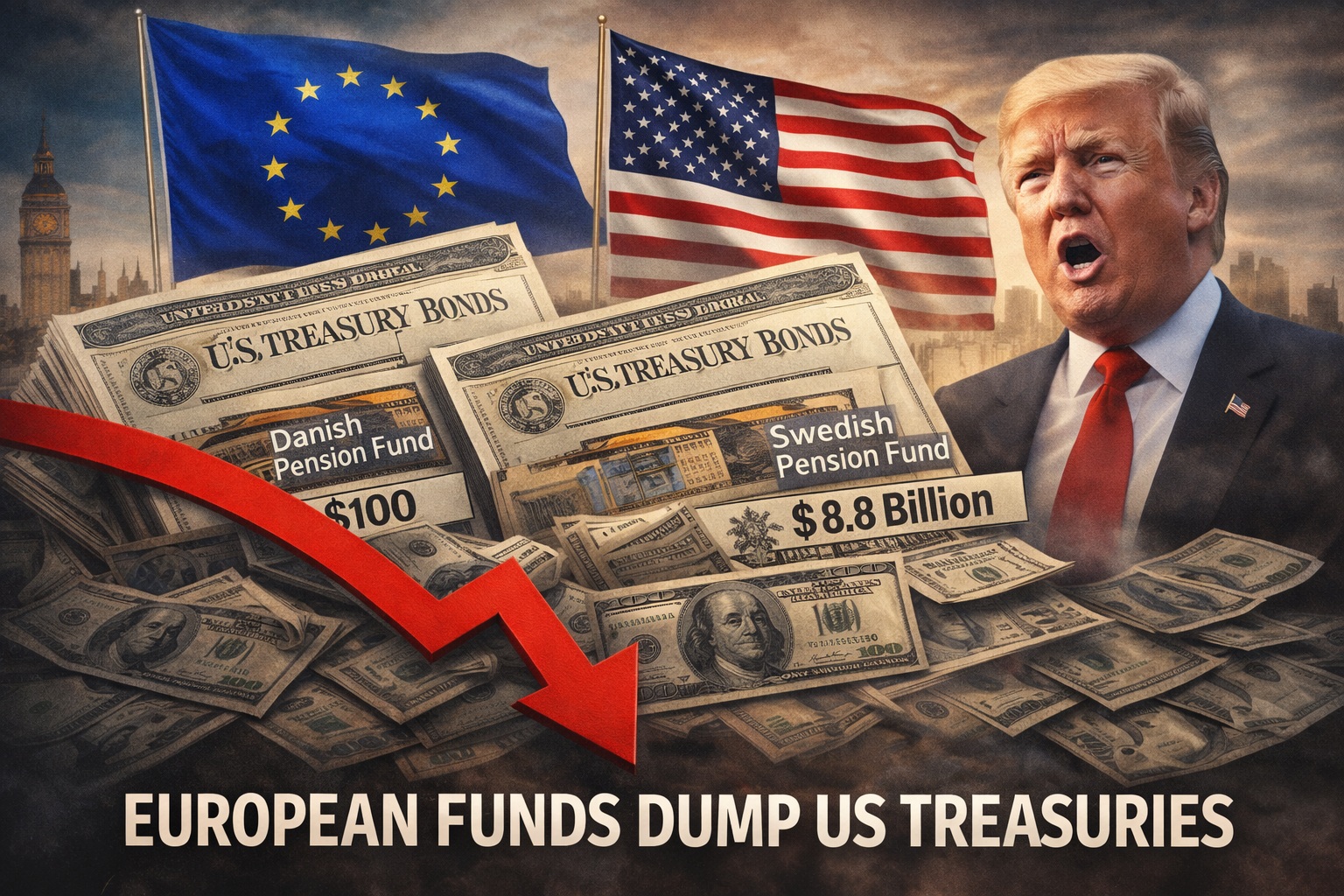
Just days after Trump cautioned the European Union against reducing its holdings of US government debt, Europe has done precisely the opposite. Two prominent pension funds, one in Denmark and another in Sweden, have confirmed large-scale sales of US Treasuries, together totaling nearly $8.9 billion. A Danish pension fund reportedly sold around $100 million, while Sweden’s government-backed pension fund AP7 offloaded an estimated $8.8 billion worth of US Treasury holdings.
What makes this move extraordinary is not the volume alone, but the reason behind it.
A Political, Not Economic, Decision
In unusually blunt statements, the pension funds involved made it clear that their decision was political rather than financial. They cited growing concerns about the rule of law in the United States, political unpredictability, and US foreign policy behavior under Donald Trump as key factors behind the sell-off.
According to the funds, even if US Treasuries continue to offer competitive returns and the dollar remains profitable, American assets are no longer viewed as politically safe. This distinction is critical: US Treasuries have long been treated by European institutions as neutral, risk-free assets insulated from politics. That assumption is now being openly questioned.
Breaking a Long-Standing Taboo
For decades, European pension funds—tasked with safeguarding long-term retirement savings—have relied heavily on US government bonds as a cornerstone of stability. Selling Treasuries for political reasons breaks a long-standing taboo in global finance, where US debt has traditionally been considered above geopolitical disputes.
This shift suggests a deeper erosion of trust. Financial markets are built not only on yields and liquidity, but also on confidence in institutions and governance. By explicitly linking their decision to political concerns, European funds are signaling that confidence in the US as a neutral financial anchor can no longer be taken for granted.
Rising Transatlantic Tensions
The backdrop to this move is a period of growing friction between the United States and Europe. Disputes over Greenland, sharp rhetoric related to NATO, and broader concerns in Europe about what it views as coercive US diplomacy and a lack of respect for European sovereignty have fueled unease across EU capitals.
Trump’s warnings against selling US Treasuries appear to have had the opposite effect, reinforcing European concerns about the use of financial dominance as a political pressure tool.
Europe Joins the De-Dollarisation Trend
Until recently, de-dollarisation was largely associated with BRICS nations, particularly China and Russia, which have sought to reduce exposure to the US dollar in response to sanctions and geopolitical risk. Europe’s entry into this trend marks a significant escalation.
As a bloc, the European Union holds approximately $1.6 trillion in US debt, making it one of Washington’s largest creditors—larger even than Japan. While the current sell-off represents only a small fraction of that total, its symbolic impact is far greater than the numbers suggest.
A Question of Trust, Not Just Money
This episode is not merely about billions of dollars being sold. It is about trust being withdrawn. Europe’s message appears clear: even close allies are unwilling to tolerate political pressure tied to financial dependence.
While the US dollar remains the world’s dominant reserve currency, developments like this underline a growing global reassessment of that dominance. The foundations of the dollar’s power—stability, predictability, and institutional credibility—are increasingly being scrutinized.
Europe’s move does not signal the collapse of the dollar, but it does mark another visible crack in its unquestioned status. In a world already drifting toward a more multipolar financial order, the decision by European pension funds to walk away from US Treasuries for political reasons could prove to be a historic turning point.