

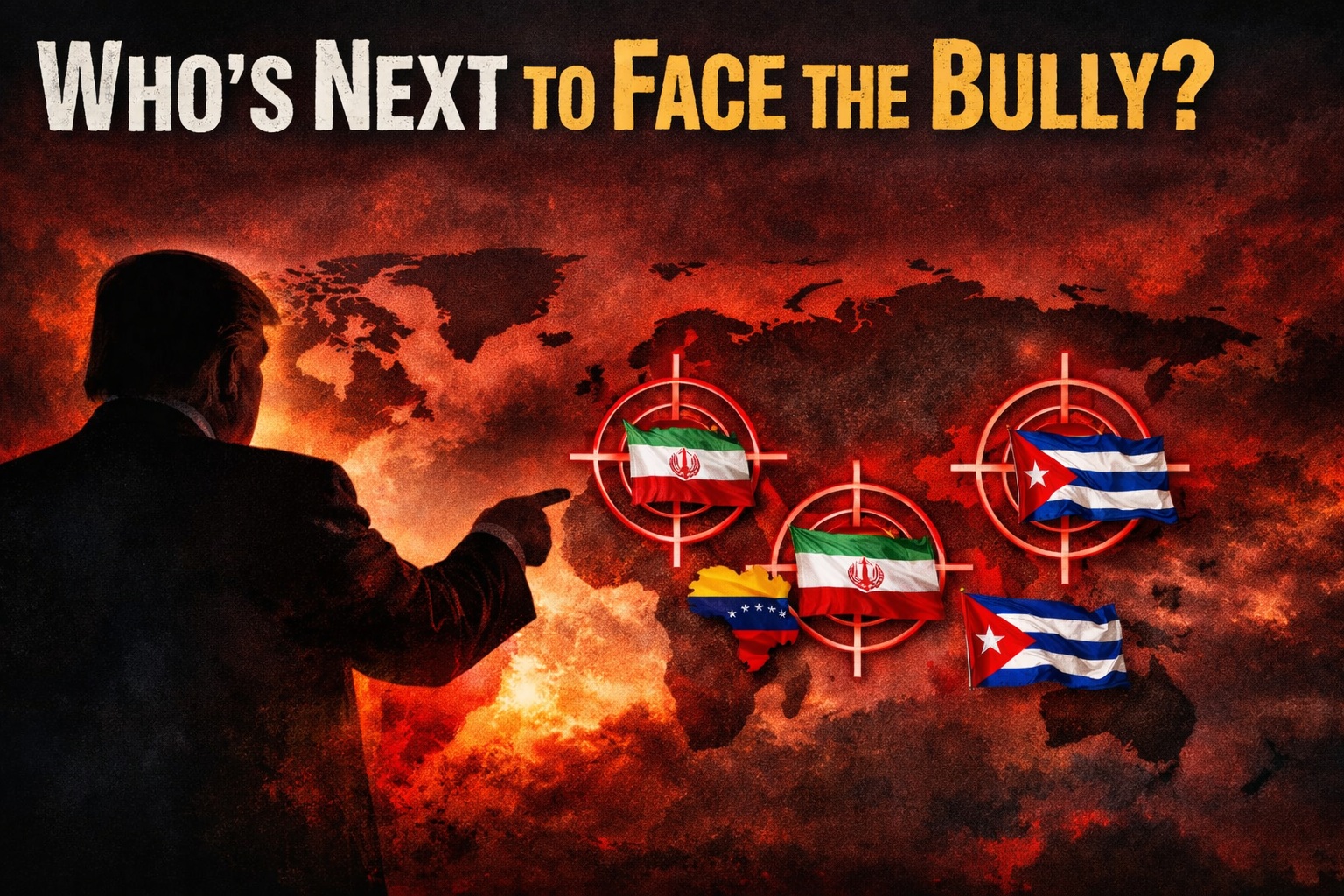

Who’s Next to Face the Bully of Trump? After Venezuela, Iran, Cuba in the Crosshairs
In a stark warning to America’s adversaries, President Donald Trump has signaled that Cuba will be the next target of U.S. pressure—adding the island nation to a growing list of countries that have faced the full force of Washington’s aggressive posture following campaigns against Venezuela and Iran.
Speaking at the White House on March 5, Trump suggested that turning attention to Cuba after concluding operations in Iran would be “just a time question,” characterizing the island’s leadership as “very desperate to make a deal” amid mounting economic strain.
The threats represent the latest chapter in what critics describe as Trump’s bullying approach to foreign policy—using maximum economic pressure, military strikes, and diplomatic isolation to force nations into submission. With Venezuela already reeling from U.S. sanctions and Iran reeling from recent military strikes, Cuba now finds itself squarely in the crosshairs.
A Pattern of Intimidation
Trump’s escalating rhetoric against Cuba follows a well-established playbook deployed against other nations perceived as hostile to U.S. interests:
- Venezuela: A crippling sanctions regime and cutoff of oil shipments that once sustained both Caracas and its Cuban ally
- Iran: Sustained military strikes targeting leadership infrastructure following the killing of the supreme leader
- Cuba: Economic blockade tightened to the point of humanitarian crisis, with fuel shortages causing cascading blackouts
The administration has employed what Trump himself describes as maximum pressure tactics. In recent weeks, he has boasted of cutting off Venezuelan oil shipments that kept Cuba’s power grid functioning, leading to a crippling jet fuel shortage that has forced international carriers to suspend service to the island.
‘Their Days Are Numbered’
Trump’s allies have amplified the confrontational rhetoric. Senator Lindsey Graham (R-SC) declared over the weekend that “Cuba’s next,” predicting the demise of what he termed the island’s communist dictatorship. “Their days are numbered,” Graham said, praising Trump’s approach as surpassing even former President Ronald Reagan’s tough stance on communism.
The president himself has floated the possibility of a “friendly takeover of Cuba,” revealing that Secretary of State Marco Rubio—himself the son of Cuban immigrants—has been engaged in “very high level” discussions with Cuban leaders.
Despite the overtures of dialogue, Cuban President Miguel Díaz-Canel Bermúdez has proven resistant to Washington’s demands. In January, he vowed Cuba would defend itself “to the last drop of blood” in response to Trump’s initial pressure campaign.
Regional Fallout
Trump’s threats against Cuba are reverberating across Latin America, where leftist governments are watching with growing alarm. The administration’s aggressive posture has left regional allies and adversaries alike calculating their next moves.
Following U.S. strikes in Iran, Cuban counterintelligence agents have reportedly increased patrols near military sites in Havana, while independent outlet 14ymedio has reported accelerated military exercises despite Cuba’s aging arsenal. The recent killing of Iran’s supreme leader in U.S. strikes has intensified fears that Washington might pursue similar decapitation-style tactics against Havana.
Some nations have expressed willingness to engage with Cuba—but only “without pressure or preconditions,” according to statements cited by Newsmax. Yet Trump’s approach leaves little room for neutrality, demanding clear alignment with U.S. interests.
Domestic Reactions
On the home front, the president brushes aside concerns about public opinion or international blowback. Despite polling showing mixed reactions to the Iran intervention, Trump insists “people are loving what’s happening.”
More than 40 civil society groups have urged Congress to press the administration to reverse its aggressive Cuba policy, warning that cutting oil shipments could precipitate a humanitarian collapse. Yet such appeals have gained little traction in a political environment where toughness on adversaries remains popular among the president’s base.
‘One of the Small Ones’
For Trump, the Cuban situation represents both a political opportunity and a personal vindication. “How long have you been hearing about Cuba—Cuba, Cuba—for 50 years?” he asked rhetorically. “And that’s one of the small ones for me.”
The dismissive characterization of Cuba as a “small one” has sparked both outrage and anxiety—if the island nation falls, who might be next on the bully’s list? Nicaragua? North Korea? Perhaps even larger adversaries like China or Russia, both of whom have watched Trump’s aggressive posture with increasing concern.
The Crosshairs Expand
As millions of Cubans endure daily power outages, fuel shortages, and rising food prices, the answer to that question grows increasingly urgent. With Venezuela already brought to its knees, Iran reeling from direct military strikes, and Cuba now squarely in the crosshairs, Trump’s message to the world is unmistakable: no nation is safe from the reach of U.S. power, and the bullying has only just begun.
For America’s adversaries and rivals watching from Caracas to Pyongyang to Beijing, the expanding list of targets serves as a chilling warning. The question is no longer whether Trump will act against his perceived enemies, but simply: who’s next?