

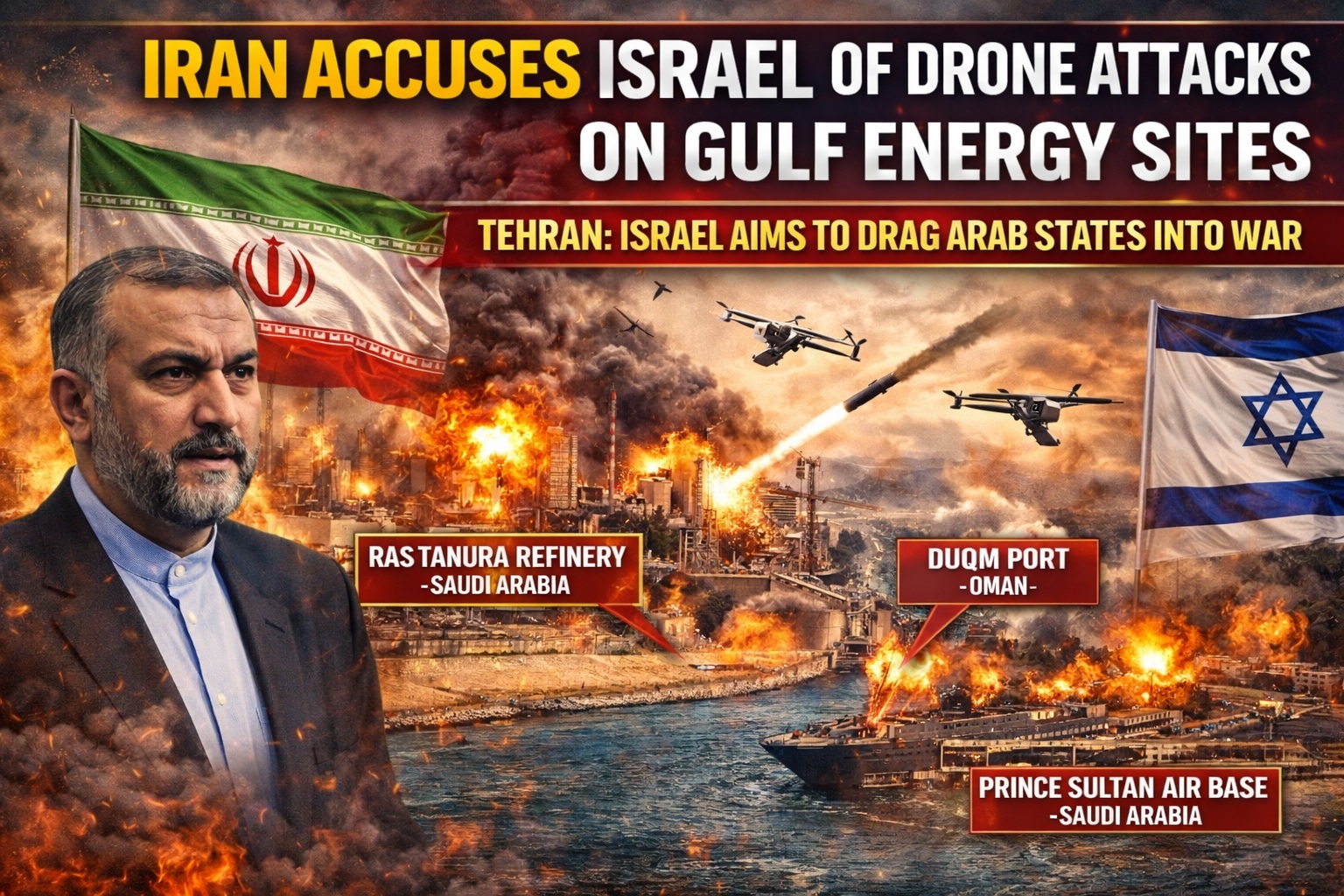

Iran Accuses Israel of Drone Strikes on Gulf Energy Sites to Draw Arab States Into War
March 5, 2026
Iranian officials have reportedly accused Israel of carrying out several drone strikes on energy and civilian sites across the Gulf, claiming the attacks are part of a calculated effort to provoke regional anger and pull Arab states into the ongoing war involving Tehran, Washington and Tel Aviv.
According to a senior official from Iran’s Foreign Ministry quoted by Middle East Eye, Israel was allegedly behind strikes targeting sites in Saudi Arabia and at least one attack in Oman.
“I can categorically say that some of the attacks were not carried out by us,” the official said, suggesting the incidents were meant to widen the conflict and shift blame toward Tehran.
Drone and Missile Attacks on Key Gulf Sites
The accusations come after a series of reported drone and missile strikes on critical facilities in Saudi Arabia and Oman. Iranian sources say at least five attacks hit Saudi targets, including the Ras Tanura Oil Refinery and the Prince Sultan Air Base, along with sites in the capital Riyadh.
Saudi authorities have also reported attacks involving drones and missiles against infrastructure connected to the energy sector and military installations.
Meanwhile, Oman confirmed that Duqm Port—a major logistics hub on the Arabian Sea that has hosted U.S. naval access since 2019—was targeted twice in recent strikes.
The Iranian official declined to specify exactly which attacks Tehran believes Israel carried out.
Iran Acknowledges Strikes on U.S. Assets
Tehran has acknowledged launching attacks on U.S. military targets across the Middle East in retaliation for joint U.S.–Israeli operations that reportedly killed Iran’s Supreme Leader Ali Khamenei and several senior Iranian military officials.
Iran says those actions were defensive responses to the strikes by the United States and Israel.
Claims of Mossad Operations
Two Iranian sources cited in the report alleged that Israel’s intelligence agency, Mossad, carried out some of the drone attacks using a covert network of agents and logistical infrastructure already established inside Iran.
According to the sources, Iranian authorities are currently searching for warehouses allegedly used by Mossad to store drones and equipment. One source suggested similar operational facilities could exist in other countries in the region.
Mossad has long been believed to maintain an extensive intelligence network within Iran and has previously been linked to covert operations targeting Iranian nuclear and military assets. These include cyberattacks on nuclear infrastructure, the seizure of sensitive nuclear documents, and the assassination of a senior Iranian nuclear scientist using a remote-controlled weapon.
Saudi Oil Facility at Center of Dispute
Another Iranian source said Tehran had privately informed Saudi Arabia that it was not responsible for the strike on Saudi Aramco’s Ras Tanura facility, which houses the kingdom’s largest domestic refinery and serves as a critical oil export terminal.
“This is an Israeli effort to sabotage regional peace and alliances between neighbours,” the source reportedly said.
Growing Pressure on Gulf States
The accusations come as Gulf nations face increasing pressure from Washington to support the military campaign against Iran. Officials from the Gulf Cooperation Council recently held a video meeting to discuss the escalating crisis.
During the meeting, foreign ministers said options for responding to Iranian attacks were still under consideration as they assess the security risks to the region.
Calls for De-Escalation
Iranian President Masoud Pezeshkian has attempted to reassure neighboring states that Tehran respects their sovereignty and does not seek a broader war.
“Your Majesties, heads of friendly and neighbouring states, we have strived alongside you and through diplomacy to avoid war, but the American-Zionist military aggression has left us no choice but to defend ourselves,” Pezeshkian said.
He added that long-term stability in the region should be achieved through cooperation among neighboring countries rather than military escalation.
Former Qatari prime minister Hamad bin Jassim bin Jaber Al Thani has also urged Gulf states to avoid direct involvement in the conflict, warning that a wider war could destabilize the region and drain resources on all sides.
Fear of Wider Regional War
Analysts say the accusations highlight the growing complexity of the Middle East conflict, where covert operations, proxy attacks and competing narratives make it difficult to determine responsibility for many strikes.
If Gulf states become directly involved, experts warn the confrontation could expand into a broader regional war with serious consequences for global energy markets and international security.