

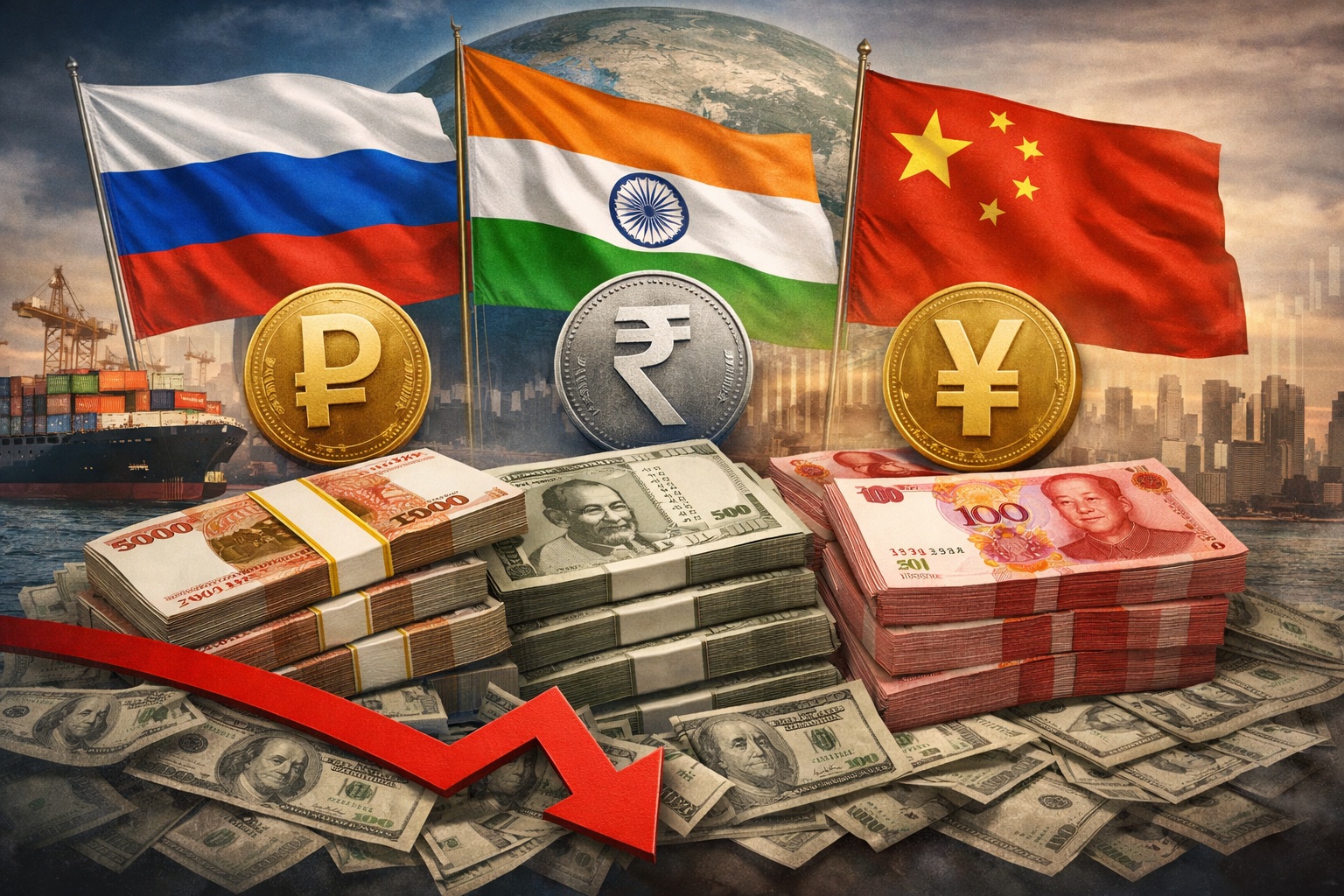

Russia’s Trade With India and China Goes Nearly Dollar-Free, Marking a Shift in Global Finance
In a development that underscores the accelerating transformation of the global financial system, Russia’s VTB Bank has confirmed that nearly 100% of the country’s trade with India and China is now being settled in national currencies rather than the US dollar. The move represents one of the clearest signals yet of the growing push toward de-dollarisation, a trend that has gained momentum amid geopolitical tensions and Western sanctions.
According to VTB, transactions between Russia and its two largest Asian trading partners are now largely conducted using the Russian ruble, Indian rupee, and Chinese yuan. This shift reflects a strategic decision to reduce exposure to dollar-based systems that are heavily influenced by Western financial institutions and regulatory frameworks.
Sanctions Accelerate a Strategic Pivot
The move away from the dollar has been gathering pace since Western sanctions imposed on Russia following the Ukraine conflict disrupted access to traditional international payment systems. Restrictions on dollar transactions, frozen reserves, and limitations on access to SWIFT highlighted the vulnerabilities associated with reliance on a single global reserve currency.
In response, Russia has fast-tracked alternative payment mechanisms and expanded bilateral currency agreements with key trading partners. Settling trade in national currencies allows Moscow to continue commerce without routing payments through US- or Europe-dominated financial channels, significantly reducing the risk of disruptions caused by sanctions.
VTB officials have described the transition as both a defensive and strategic step, aimed at safeguarding trade flows while laying the groundwork for a more resilient financial architecture.
What It Means for India
For India, the increased use of the rupee in trade with Russia brings several potential advantages. Settling transactions in local currencies can lower transaction costs by eliminating the need for dollar conversion, reduce exposure to exchange-rate volatility linked to the US currency, and improve settlement efficiency.
More importantly, the development strengthens the international profile of the Indian rupee. While the rupee is still far from being a global reserve currency, its growing use in bilateral trade supports New Delhi’s long-term ambition to enhance the currency’s global role and reduce dependence on the dollar for external trade.
Indian importers, particularly in sectors such as energy, defense, and commodities, may also benefit from smoother payment mechanisms that are less vulnerable to geopolitical shocks.
A Boost for the Chinese Yuan
For China, Russia’s shift reinforces Beijing’s broader push to internationalise the yuan. Over the past decade, China has steadily expanded the use of its currency in cross-border trade, energy deals, and financial markets.
Increased yuan-denominated trade with Russia strengthens China’s position as a central player in an emerging non-dollar trade ecosystem. It also aligns with Beijing’s long-term strategy of reducing exposure to dollar-centric systems and building parallel financial infrastructure, including alternative payment networks and clearing mechanisms.
Not the End of the Dollar — But a Warning Sign
Despite the significance of this development, analysts caution that it does not signal the collapse of the US dollar. The dollar remains the world’s dominant reserve currency, accounting for the majority of global foreign exchange reserves, international debt, and cross-border transactions.
However, the Russia-India-China trade shift is widely seen as a symbolic and practical challenge to the dollar’s unquestioned dominance. As more countries explore local-currency trade arrangements, particularly in Asia, the Middle East, and parts of the Global South, the global financial system is gradually becoming more fragmented and multipolar.
Rather than a sudden displacement of the dollar, experts describe the process as a slow rebalancing—one in which the dollar remains powerful but no longer singularly dominant.
Toward a Multipolar Financial World
The growing use of national currencies in international trade reflects a broader realignment of economic power. Countries seeking greater financial sovereignty are increasingly motivated to diversify away from the dollar, especially when geopolitical risks intersect with economic policy.
Russia’s near-complete transition to local-currency trade with India and China may serve as a model for other nations looking to reduce exposure to sanctions and external financial pressure. If replicated on a wider scale, such arrangements could gradually reshape global trade norms.
While the dollar is unlikely to disappear from the world stage anytime soon, its monopoly over international trade settlement is clearly being challenged. The rise of local-currency trade marks a step toward a multipolar financial system—one where economic influence is shared across multiple currencies rather than anchored to a single one.